Facing second DWI penalties in New York puts you in a much tougher spot than a first offense.
“A second conviction within 10 years is charged as a Class E felony under New York Vehicle and Traffic Law Section 1193,” which brings mandatory jail exposure, an ignition interlock requirement, and a longer license revocation.
That felony threshold is exactly why the choice between a negotiated plea and a trial carries so much more weight the second time around.
This article walks you through what each path actually involves so you can make a decision that fits your situation, not a generic one.
Choosing between a plea deal and a trial for a second DWI comes down to how strong the evidence against you is and how much risk you can accept.
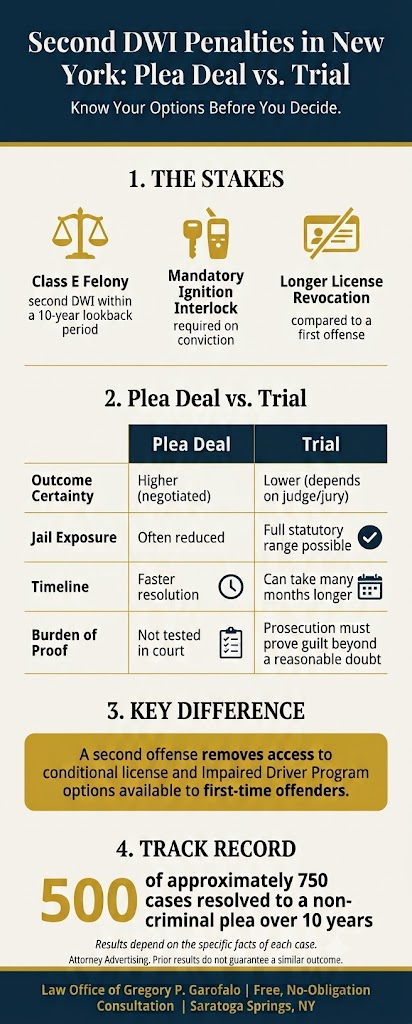
Second DWI Penalties in New York: Plea Deal vs. Trial
A plea deal trades some certainty for a lower ceiling on punishment, while a trial keeps every option open but raises the stakes if it does not go your way.
| Factor | Plea Deal | Trial |
| Outcome certainty | Higher terms are negotiated in advance. | Lower, depends on judge or jury |
| Jail/prison exposure | Often reduced through negotiation | A full statutory range remains possible. |
| Timeline | Typically faster resolution | Can take many months longer |
| License impact | May be softened as part of the deal | A full revocation period applies if convicted. |
| Burden of proof | Not tested in open court | The prosecution must prove guilt beyond a reasonable doubt |
What Negotiating a Plea Deal Can Achieve
A negotiated plea for a second DWI charge works by giving the prosecutor a reason to accept a reduced outcome before the case ever reaches a jury.
How a Negotiated Reduction Changes Felony Exposure
The value of a plea negotiation on a second offense is that it can move a case away from the mandatory felony track before sentencing ever happens.
Attorney Garofalo reviews the traffic stop, the breath or blood test procedure, and your prior record for weaknesses the prosecution needs to avoid at trial.
Every case is different, and results depend on the specific facts involved, but this is the type of negotiated resolution that repeat driving-related clients have experienced:
“Attorney Garofalo represented me at Queensbury Town Court after I was charged with Aggravated Unlicensed Operation in the second degree.
He worked to get it reduced down to a third-degree AUO, which meant I didn’t face any jail time or probation. His work was awesome, and I’d highly recommend him to anyone dealing with something similar.“ —Sarah, client
Why Timing and Evidence Review Affect What Is Negotiable
Prosecutors weigh plea offers differently depending on how early your attorney raises procedural or evidentiary issues. Waiting too long to challenge a breath test calibration record or a stop’s legal basis can close doors that were open just weeks earlier.
Case timelines matter: New York DWI cases typically require a court appearance within two weeks of the violation, so early review gives your attorney more leverage.
Track Record Context
Attorney Garofalo has personally handled approximately 750 driving-related cases over the past 10 years, with roughly 500 of those resolved to a non-criminal plea.
That direct negotiation experience across Saratoga, Warren, and Albany County courts shapes how a plea offer gets structured on a second-offense case.
What Going to Trial Involves
A trial keeps your right to a full acquittal on the table, but the prosecution only needs to prove its case beyond a reasonable doubt once for the maximum penalty to apply.
You keep the ability to challenge the traffic stop, the chemical test, and the arresting officer’s account in open court.
The Tradeoff is Time
Trials generally add months to a case that a plea could resolve much faster, and if the verdict goes against you, the court is not bound by any of the reductions a negotiated deal might have offered.
The Key Differences That Matter
Two factors specific to a second offense change this decision more than most drivers realize, and neither gets much attention in general DWI guides.
Felony Exposure and Mandatory Ignition Interlock on a Second Offense
“A second DWI conviction within 10 years triggers a mandatory ignition interlock device requirement and Class E felony sentencing exposure under New York Vehicle and Traffic Law Section 1193.”
That single fact raises the cost of losing at trial far above what a first-time offender faces, which is why the plea-versus-trial decision on a second charge deserves a different level of scrutiny than the same question on a first offense.
Loss of First-Offense Program Eligibility
A second offense also typically removes access to the conditional license and Impaired Driver Program options that many first-time offenders use to keep driving during their case.
Losing that safety net changes what a favorable plea needs to accomplish, since it may need to address license restoration alongside the criminal charge itself.
According to the New York State DMV, Penalties for Alcohol or Drug-Related Violations, “license actions for repeat alcohol-related violations carry longer minimum revocation periods than a first offense.”
Which Option Is Best for You?
Plea Deal Fits You If
The evidence against you (breath test results, officer testimony, prior record) is strong, and reducing your exposure to felony sentencing matters more than a shot at full acquittal.
Trial Fits You If
There are real weaknesses in the stop, the test procedure, or the officer’s account, and you are prepared for a longer timeline in exchange for the chance at a full dismissal.
Either Way
The right choice depends on the specific facts of your arrest, not a general rule that applies to every second DWI case.
Frequently Asked Questions (FAQs)
Q1. Can a second DWI in New York be reduced to a DWAI?
In some cases, a second DWI charge can be negotiated down to a DWAI (Driving While Ability Impaired), which carries lower fines and no felony record.
Whether this is available depends on the strength of the evidence and your specific case history. An attorney familiar with local prosecutors is often better positioned to know when this option is realistic.
Q2. What makes a second DWI a felony in New York?
A second DWI conviction becomes a Class E felony when it occurs within 10 years of a prior DWI, DWAI-drug, or combination-related conviction under New York Vehicle and Traffic Law Section 1193. Outside that 10-year window, the charge is typically treated as a misdemeanor instead.
Q3. How long does a second DWI case take to resolve in New York?
Second DWI cases generally take longer than first offenses because of the added felony-level procedures involved. Resolution timelines commonly range from four months to two years, depending on court schedules, evidence review, and whether the case is resolved by plea or trial.
Q4. Is it better to fight a second DWI at trial or negotiate a plea?
There is no universal answer, since it depends on the strength of the evidence, your driving history, and how much risk tolerance you have for the felony exposure to a trial carries. A case-specific review of your stop, test results, and prior record is the only reliable way to decide.
Q5. Does a second DWI affect my driver’s license differently than a first offense?
Yes. A second DWI conviction typically carries a longer minimum revocation period and removes access to certain conditional license programs available to first-time offenders.
Making the Right Call on Your Second DWI Charge
Second DWI penalties in New York carry real felony consequences, and the choice between a plea deal and a trial should reflect your specific evidence, history, and goals rather than a one-size-fits-all approach.
A direct conversation with an attorney who has personally negotiated hundreds of driving-related cases in Saratoga, Albany, and Schenectady County courts is the clearest way to understand which path fits your situation.
Call the Law Office of Gregory P. Garofalo at GETGARF today for a free, no-obligation consultation to discuss your case.