

Facing a DWI charge in Malta, New York, means facing two decisions at once: how to defend the case and how to pay for it. Search results for attorney fees rarely agree, and every website claims its billing method protects you best.
If you are not sure how to compare a fixed fee against an hourly rate, this guide breaks down exactly where the cost risk sits in the Malta DWI court process.
A fixed fee sets your total legal cost before the case begins. Hourly billing sets your cost by how long the case takes to resolve.
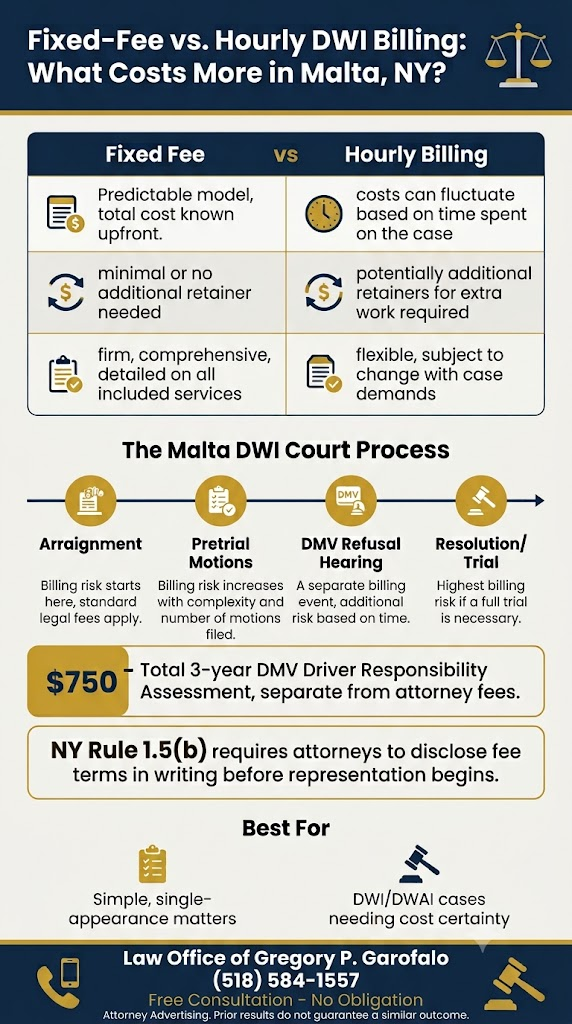
Fixed-Fee vs. Hourly Billing in the Malta DWI Court Process
The two models differ mainly in who carries the financial risk once a case gets complicated.
| Factor | Fixed Fee | Hourly Billing |
| Cost predictability | Set at the start | Changes as work adds up |
| Retainer refresh risk | Rare | Common in longer cases |
| Fits arraignment-only cases | Yes | Yes |
| Fits cases with motions or hearings | Yes, the cost stays the same | Cost rises with each stage |
| Fee agreement clarity | One number, one scope | Rate plus estimated hours |
What a Fixed-Fee DWI Defense Gets You
A fixed fee ties your total cost to the work your case actually needs, not to a running clock.
A flat rate for DWI defense means the attorney prices the case once, based on the charge, the evidence, and the likely path through the Malta DWI court process.
You know the number before you sign anything, and that number does not move because a hearing gets rescheduled or a motion takes longer than expected.
One client who hired the Law Office of Gregory P. Garofalo for a cell phone violation put it directly:
“I looked into a few local attorneys before deciding to go with Mr. Garofalo, and I’m glad I did. He jumped on my case right away, and honestly, his fees were more than reasonable for the work he put in.”
That kind of feedback reflects a fee structure built around the work performed, not around billable hours stacked on top of each other.
This matters because a Malta DWI case rarely ends at arraignment. It moves through pretrial motions, sometimes a DMV refusal hearing, and eventually a resolution or trial date.
Attorney Garofalo has represented drivers in Saratoga and Warren County courts for 35 years, handling approximately 750 cases over the past 10 years, with about 500 of those resolved to a non-criminal plea.
A pricing model built on that volume of casework tends to reflect real effort rather than guesswork.
A fixed fee does have one honest limitation. If a case shifts significantly, for example, moving from a plea negotiation toward a full trial, the original fee agreement may need to be revisited. A trustworthy attorney will say this upfront rather than let it surprise you later.
What Hourly Billing Offers
Hourly billing charges a set rate for each hour of work performed, tracked, and invoiced as the case moves forward.
This model can suit a very simple, single-appearance traffic matter where the total time involved is small and predictable. For a DWI case that includes multiple court dates, evidence review, and negotiation with the prosecutor, the total cost is not known until the case ends.
Clients typically receive itemized invoices and may be asked to replenish a retainer once the initial funds are used.
The Key Differences That Matter
The real difference is not the billing method itself; it is who absorbs the cost if the Malta DWI court process takes longer than expected.
Hourly billing can look cheaper at the start of a case, since the initial retainer is often smaller than a full fixed fee. Yes, the entry cost may be lower, but that structure shifts the financial risk of extra hearings, motions, or delays onto you as the case unfolds.
“New York’s Rule of Professional Conduct 1.5(b) requires a lawyer to communicate the scope of the representation and the basis or rate of the fee and expenses for which the client will be responsible, before or within a reasonable time after the representation begins.”
A fixed fee gives you one number to plan around from day one. Yes, that number is set early, but it still needs full written disclosure so you understand exactly what it covers before the case begins.
The same Rule 1.5(b) disclosure requirement applies to fixed-fee agreements, which is why a clear, written scope matters regardless of which billing model you choose.
What Fixed-Fee vs. Hourly Billing Looks Like at Each Stage of the Malta DWI Court Process
Billing risk is not spread evenly across a DWI case; it concentrates at specific stages of the Malta DWI court process.
Arraignment Stage
Both billing models usually involve similar upfront work, including reviewing the charge, entering a plea, and setting the case calendar.
Pretrial Motions Stage
Hourly costs can climb quickly here as the attorney reviews evidence and files paperwork, while a fixed fee stays the same.
DMV Refusal Hearing, If Applicable
This cost sits outside attorney fees entirely.
“New York imposes a separate Driver Responsibility Assessment of $250 per year for three years, totaling $750, for anyone convicted of an alcohol or drug-related driving offense, under and confirmed on the NY DMV Driver Responsibility Assessment page.”
Resolution or Trial Stage
Hourly billing risk peaks here, while a fixed fee continues to hold at the number agreed upon at the start.
Which Billing Option Is Best for You?
Hourly billing tends to fit drivers managing a single, low-complexity traffic matter who are comfortable with an open-ended final cost.
A fixed-fee DWI defense tends to fit drivers facing a DWI or DWAI charge in the Malta DWI court process who want to know the full legal cost before the case even starts.
Frequently Asked Questions (FAQs)
Q1. How much does a DWI attorney cost in Saratoga County?
Costs vary by case complexity, whether the charge is a first offense or a repeat offense, and whether the attorney bills a fixed fee or an hourly rate. A written fee agreement should outline the exact basis before you commit to representation.
Q2. What is the difference between a retainer and an hourly fee?
A retainer is an upfront payment held against future work, while an hourly fee is the rate charged for each hour actually worked. Hourly billing draws down the retainer as the case proceeds and may require replenishment.
Q3. Does the DMV Driver Responsibility Assessment count toward my attorney’s fee?
No. The Driver Responsibility Assessment is a separate state-mandated cost of $750 paid to the DMV over three years for alcohol or drug-related convictions, and it exists independent of whatever your attorney charges for representation.
Q4. Can a DWI attorney’s fee change mid-case?
A fixed fee may need to be revisited if the case scope changes significantly, such as moving toward trial. An hourly fee changes naturally as more time is billed, which is why the total cost is harder to predict from the outset.
Q5. Is a written fee agreement required for the Malta DWI court process?
Yes. New York Rule of Professional Conduct 1.5(b), found in 22 NYCRR Part 1200, requires attorneys to communicate the scope of representation and the fee basis in writing before or shortly after the work begins, regardless of billing model.
Get Clarity on Your DWI Defense Cost Before You Decide
Comparing fixed-fee and hourly billing matters, but the more useful step is getting a real number for your specific situation in the Malta DWI court process.
The Law Office of Gregory P. Garofalo offers a free consultation with no obligation to proceed, and every call is returned within 30 minutes.
Call the Law Office of Gregory P. Garofalo today to get a clear, upfront picture of your defense cost before your next court date.