
When you search for a way to challenge an old New York conviction, you run into a wall of conflicting terms. Appeal. Motion to vacate. Coram nobis. Every page claims to explain your options, but few tell you which one actually applies to your situation.
A Coram Nobis attorney in Saratoga Springs, NY, can tell you the difference in minutes, but the internet rarely does.
This guide breaks down coram nobis and direct appeal side by side, so you know which path fits a conviction that is still affecting your license, your job, or your immigration status.
Coram nobis and direct appeal solve two different problems, and confusing them can cost you a filing deadline you cannot recover.
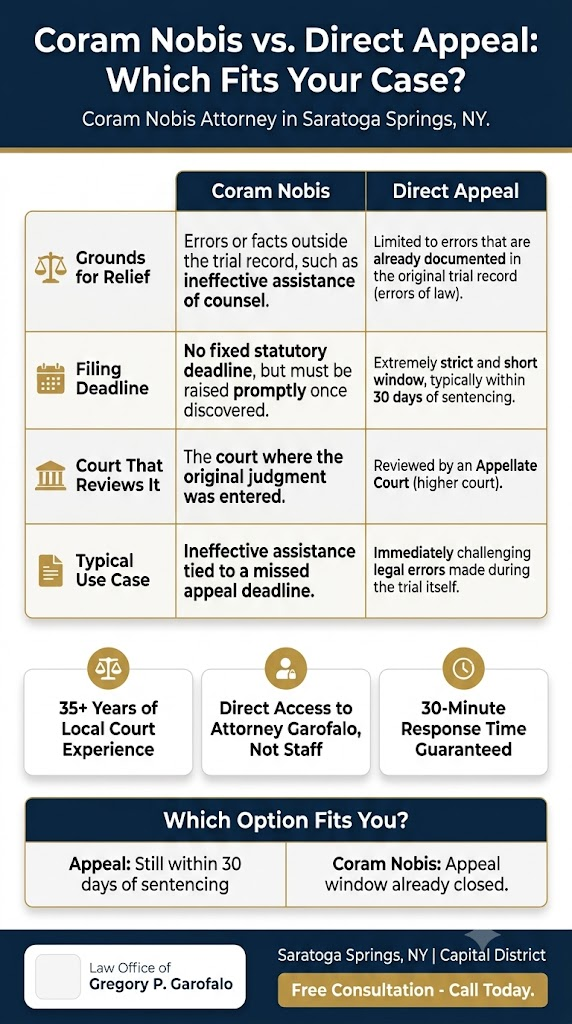
Quick Comparison: Coram Nobis vs. Direct Appeal in New York
Coram nobis exists for the rare situation where no other procedure reaches the problem, while a direct appeal works only within the boundaries of the existing trial record.
| What You Need | Coram Nobis | Direct Appeal |
| Grounds for relief | Errors or facts outside the trial record | Legal errors preserved in the trial record |
| Filing deadline | No fixed statutory deadline, but must be raised promptly once discovered | 30 days from sentencing |
| Court that reviews it | The court where the original judgment was entered | Appellate division or county court |
| Typical use case | Ineffective assistance tied to a missed appeal deadline | Trial court errors on legal or evidentiary rulings |
According to the New York Court of Appeals decision in People v. Tiger, “the coram nobis writ exists to “alleviate a constitutional wrong when a defendant has no other procedural recourse,” a standard first set out in People v. Syville and reaffirmed in Tiger.”
What a Coram Nobis Attorney in Saratoga Springs, NY, Does Best
Attorney Gregory P. Garofalo has spent 35 years representing drivers across Saratoga Springs, Albany, Schenectady, and the surrounding Capital District, and that same local court knowledge applies when an old conviction still needs to be corrected.
A coram nobis petition often comes down to proving a very specific, narrow failure in how a case was originally handled, and that requires someone who knows how these courts actually work.
Across 750 cases handled over the past 10 years, Attorney Garofalo has resolved roughly 500 to a non-criminal plea. That kind of case history matters just as much when the goal is undoing a conviction as it does when the goal is preventing one.
Direct Attorney Access From Filing Through Resolution
You work with Attorney Garofalo personally, not a rotating team of associates, from your first call through the final court decision. He confirms a maximum response time of 30 minutes from the moment you reach out.
Local Court Familiarity Across Saratoga, Warren, and Albany Counties
Nine out of ten of Attorney Garofalo’s cases come out of Saratoga and Warren counties, with Albany’s Town of Colonie as the largest court in his caseload. That local footprint shapes how a coram nobis petition gets prepared and filed in the exact courtroom where your original judgment was entered.
Matching the Right Post-Conviction Remedy to an Old DWI or AUO Conviction
Most guidance online treats coram nobis as a generic legal concept and stops there.
It rarely addresses what happens when the conviction in question is a DWI or an Aggravated Unlicensed Operation (AUO) charge that is now affecting a license renewal, a job application, or an immigration filing years later.
A driving-related conviction does not automatically qualify for coram nobis just because it is old.
The remedy only fits if the original failure meets the narrow legal standard, such as a missed appeal deadline caused by ineffective counsel, not simply regret over the outcome. Reviewing your specific conviction against that standard is the first step before any petition gets filed.
What a Direct Appeal Involves
An appeal reviews legal or evidentiary errors that already appear in your trial record, such as a wrongly admitted piece of evidence or an incorrect jury instruction.
“You must file a Notice of Appeal within 30 days of sentencing, as confirmed on the New York State Unified Court System criminal appeals page.”
Once filed, the appellate court reviews the existing trial transcript rather than considering new facts. This path works only if your deadline has not already passed and the issue was preserved during trial.
The Key Differences That Matter
The real difference is not which remedy sounds more serious. It is whether your specific problem fits inside the record or outside it.
Yes, an Appeal Preserves Trial-Record Errors, But It Has a Strict 30-Day Deadline
A direct appeal can correct real mistakes made during trial, but that door closes fast. Miss the 30-day window, and the appeal route is gone regardless of how strong your underlying issue is.
Yes, Coram Nobis Reaches Facts Outside the Record, But It’s Reserved for Narrow Circumstances
Coram nobis can address problems an appeal cannot touch, such as ineffective counsel that cost you your appeal rights entirely.
That flexibility comes with a tradeoff: courts apply this remedy only when a defendant has no other procedural recourse, which means “most post-conviction claims are resolved through a CPL 440.10 motion to vacate judgment before coram nobis ever becomes relevant.”
Which Option Is Best for You?
A direct appeal is best for drivers who are still within 30 days of sentencing and believe a specific legal or evidentiary error occurred during trial.
A coram nobis petition is best for drivers in Saratoga Springs or the Capital District whose appeal window has already closed and who lost that window through a failure that was not their own, such as ineffective assistance of counsel.
Frequently Asked Questions (FAQs)
Q1. Can I still file a coram nobis petition years after my New York conviction?
Yes, coram nobis has no fixed statutory deadline, but you must raise it promptly once you discover the underlying problem. Courts expect the petition to be filed without unreasonable delay after you learn about the issue.
Q2. What is the deadline to file a direct appeal in New York?
You must file a Notice of Appeal within 30 days of sentencing. This deadline is strict, and missing it generally closes the direct appeal path for good.
Q3. Does a coram nobis petition affect my immigration status the same way an appeal would?
An old conviction can carry immigration consequences regardless of which remedy you pursue, but coram nobis specifically addresses cases where an appeal was never properly available to you in the first place.
Q4. Will Attorney Garofalo personally handle my coram nobis case?
Yes, Attorney Garofalo handles every aspect of your case personally, with a confirmed 30-minute response time to your initial call.
Q5. What happens if I am not sure which remedy fits my situation?
A free consultation lets you walk through your specific conviction and timeline before deciding, since the right remedy depends entirely on the facts of your original case.
Making Your Decision
Whether your situation calls for a direct appeal or a coram nobis petition depends on one question: did your appeal rights close through your own missed deadline or through a failure you had no control over?
That distinction determines which path is even available to you.
If an old DWI or AUO conviction in Saratoga Springs or the Capital District is still following you into a license renewal, a job, or an immigration matter, call the Law Office of Gregory P. Garofalo, your Coram Nobis Attorney in Saratoga Springs, NY, for a free, no-obligation consultation.